Wednesday, December 16, 2009

Why do men cheat?

In the wake of the Tiger Woods scandal, USA Today asks why men cheat. Personally, I think it’s the wrong question. Biologically, men are sperm production machines. We release roughly 40 million of the little buggers every time we ejaculate. This fact simultaneously contributes to, and is a result of, a strategy for increasing the number of human beings in the world. This strategy has been exercised by men and women for tens of thousands of years. Some of the elements of this strategy:
  1. The fact that women have ridiculously small production of eggs compared to men’s production of sperm, means that women are in general, more selective about their sexual partners. They want both:
    1. Men who will commit a lifetime to them in order to help provide stable child care
    2. Men with the strongest genetic material, to increase the odds of survival of their children
    This often results in a problem for women, because of this statistical fact: not all women can have above average lifetime mates. By definition, not all men are above average. There’s no getting around the fact that, on average, men are average. So, on average, women find themselves choosing either a or b, but not both.

  2. On the other hand, men’s production of ridiculously large numbers of sperm means that sperm are in plentiful supply. To replace the current generation, any given society needs to have all (or nearly all) of the women reproduce. But only a very small number of men are needed to accomplish the same thing. The rest of the men are expendable. Hence, they are available to take on the much more risky tasks, like protecting the group from invaders, getting meat, etc.
The results of the extremely high costs of female eggs and the extremely low costs of male sperm is the strategy that got us to where we are today: relatively small number of men have historically reproduced. The remaining men simply died off. Those who did reproduce, had to be among the horniest buggers of all time. Those who weren’t that horny simply died off.

So what are men now? We’re the descendents of long lines of the horniest and most reproductive men ever. This tiny minority of men had sex with almost all the women. The women wanted this because they all had access to the best genes which meant a higher probability that their children would survive. The men wanted this because it let them spread their genes most widely. The offshoot? Men are horny buggers because we’re descended from horny buggers. And women enabled this trait by giving birth to offspring from that tiny minority of men.

And this is borne out by studies of genetic lineage. Some studies of China have found that 8% of that population is a descendant of Genghis Khan (1). Think about that. One out of every 12 people, in a society of over 1 billion, are descended from one man. Other studies have found that, historically, only 40% of males reproduced. The remaining 60% died before having children (2).

The long and short: all of us (in general) but specifically men have an incredible biological urge to promiscuity, because we are descended from long lines of men who successfully deployed this strategy, and we inherited the desire to do the same.

So the question is *not* why do men cheat. The question is why don’t they.

And the answer is, I think, related to how marriage benefits the 60% of men who previously didn’t get to reproduce. Without the institution of marriage, almost all women would reproduce. But only 40% of men would. Marriage, and the social pressure to remain faithful, provides benefits for both men and women. For most women it provides them a long term caretaker. For men, it provides that other 60% the ability to reproduce. An ability that they simply didn’t have before.

Marriage is, I think, an emergent social norm that maximizes reproduction for both men and women. It’s a good thing. *BUT* don’t forget our biological history. It’s that history of success that makes it so hard for men to not cheat. Men find themselves trying to walk a tightrope. They have enormous biological pressure pushing them towards infidelity, and social pressure pushing them towards faithfulness. It should be little surprise that several slip off that rope.

UPDATE: I just realized something. A) I am a lifetime companion to my wife. B) I've never been approached or seduced by any woman, ever. I therefore have to conclude that, apart from marraige, I'd have fallen into the 60% of men who never got to reproduce. This conclusion is corroborated by my experience in high school, and the observations of a former boss. After work at the bar, he told me I had "no game" - meaning that I couldn't pick up a woman if I really wanted to. I objected saying that I got married and was able to pick up at least one woman. His response: that was just pity. Over the years, I've come to realize he was right. My point: there's at least one positive about being in the bottom 60%.

Cited References:
  1. http://news.nationalgeographic.com/news/2003/02/0214_030214_genghis.html
  2. http://www.psy.fsu.edu/~baumeistertice/goodaboutmen.htm FYI, this article is worth reading in its entirety.
Additional references:
  1. http://jessiegirl.blogspot.com/2008/11/monogamy-part-1-impossible-dream.html
  2. http://opinionator.blogs.nytimes.com/2008/09/16/a-commitment-pill/?apage=3

Sunday, December 06, 2009

First Story, Part 2

Just a short update for those who are following along with what we're doing to try and make the life of a kid better and at the same time, make a better story of our own lives.

Yesterday, my wife & I spent almost all day in an orientation session to learn about hosting an orphan from Latvia over Christmas.  Here are the big things I came away with:
  1. The importance of avoiding the a-word could not be stressed enough. Despite the fact that he will know very little english, the a-word is one that he'll know. They really don't want to raise the expectation levels of the kids only to have them be disappointed.
  2. To that end, the kids who are hosted won't find out that they're going until right before they leave.  As I understand it, someone will show up, ask them to pack and then they go. On the way to the airport, they'll get a letter that was written by the hosting family - translated into their native language. Ours included pictures and a small description of each family member. The pictures we included were a picture of the whole family, a picture of the room he'll stay in and a couple of pictures of the kids playing with the dog (so that he'll know we have a dog, and that the dog is friendly with even the little kids).
  3. A statistic was presented: 30% of people who host describe themselves as "open" to the a-word, but 70% actually adopt. To which, I said, out loud, "Aww. Crap!"
  4. After he's been here for 2 weeks, we will receive a form from "the organization" that's coordinating all of this. We will have to answer this question: do you wish to adopt the child you're hosting. We will have to answer either: "Yes", "No", or "Uncertain". If we answer "Yes" the child will be taken off of the organizations web site completely.  If we answer "No" the child will be put back on the website in order to encourage other families to host, and possibly adopt. If we answer "Uncertain" the child will be put back on the website. In this case, if someone else decides to pursue adoption they will contact us first to determine if we'd made a decision.  My reaction: wow that's not a lot of time to be able to make that big of a decision.
The orientation session was good, but it could have been more efficient. I felt like they covered a lot of stuff that was in the required reading. By the end of the day, I was getting pretty fidgety. But we did meet many of the other families that will be hosting in our area as well as some who'd flown in from the entire opposite side of the country. I really enjoyed meeting them. We've already planned one group activity. We are hopeful for more. Group activities are good for the kids because they get to interact with other kids in their own language.

When I told my mom about this, she thought we were completely crazy. I took that as a good sign that we're achieving at least one of our goals with this.

Other things we know now that we didn't when I wrote the first post:
  • The child's flight will arrive at 11:52pm on a school night. They encourage the entire family to be there and to be excited. I'm not sure how we'll pull that off. My wife wants me and my oldest son to go while she stays home with the younger 3. This is not the kind of thing I get really hyped up about. So it may take some divine intervention to get me excited.

    And the kid will just have spent the previous 30 hours traveling. Which seems like a long time until you put that into perspective that he's only known about who he was going to meet 30 hours earlier. So, he'll be exhausted and nervous at the same time.
  • So far, our criminal checks have come back containing exactly nothing. Which is oddly relieving. I didn't expect them to contain anything, but I couldn't avoid the paranoia that they might contain something for which we were wrongly implicated.  
  • The FBI investigation has not yet been received. We have to call the FBI and ask them to expedite. The friends of ours who got us into this program did the same thing, and the FBI had lost their requests. It's pretty late in the game, I really hope they have not lost ours.
  • The paper work that I fretted about was either not as hard as I thought, or my wife (having done nearly all of the work) did a fantastic job of hiding that effort from me.
We have pictures of the child that we're hosting. I was thinking of posting them here, but that's problematic. I may have already spoken too much about our consideration of the a-word. I don't want to get "the organization" in trouble, as they are only a hosting organization, not an adoption agency.

Friday, December 04, 2009

401(k)ar

In order to teach about the benefits of long term savings (in general) and, more specifically, of employer contributions through 401(k) plans, we have established for our first born (12 years old) a 401(k)ar account. The deal with this plan is that whatever money he puts into it, we will match 100%. He's 4 years away from getting a car, so I figure if he can put $25/mo into it that'll be about $2400 (after we match) over 4 years.  That ought to be enough money to get a good beater-up car for pretty low insurance costs.

And I'm so proud of him. He took the $50 that he received from his Grandma and put it in the account. So he's got $100 in there now.

Wednesday, November 11, 2009

First Story, Part 1

I have an accomplishment to announce. To you it won’t seem like much, but really it’s quite something. I finished a book. No, really. I did. Ok, so, yeah, you’re right. It’s not much. But you have to understand why, for me, it’s bigger than you might think. I’m a terrible finisher. I can start a *ton* of things. But finishing things is another story altogether. I just don’t like the idea of that particular experience being over. So I leave stuff unfinished. Now there’s a lot of stuff that I leave unfinished that I just hated.  But there’s also a large number of things that are unfinished because I like the idea of having some of it left.  I’d much rather delete something from my harddisk than have to deal with running out of space. I keep buffers for everything. My dresser has empty space in it… well it had empty space in it.  My wife makes sure to fill all available storage.

Long and short: When I really like a book and when I really don’t like a book – it looks the same. I have a hard time finishing it.

So it’s somewhat remarkable that I finished a book that I really, really liked. The book is called A Million Miles in a Thousand Years by Don Miller. It’s about story. And, in particular, how the elements required to make a good story might also be the elements required to make a good life. Miller asks us to imagine a character who isn’t likeable, pursuing something that isn’t worthwhile, in a setting that isn’t memorable, against minimal conflict, and then wonders if anyone would ever consider making that story into a movie. Imagine the final scene of this movie where the character finally drives his newly acquired BMW off the lot, and rides it into the sunset in tears. I can only imagine this scene being actually produced in something like Scary Movie, or the other comedic mockeries of other movies.

Miller’s point is that if the only thing we strive for in life is as trivial as getting the BMW (or a cell phone), then that’s just as much a mockery of real life as the above scene is a mockery of a real movie. It should be no wonder that amidst that type of living, we find people who are dejected and overwhelmed while living in a society with more money, leisure and luxury than any other in the history of the world.

When I look at my life, I see a pretty comfortable life. I love my wife. I love my children. But I also see a life that would make a terrible movie. Let’s compare me to the elements in a story:
  1. Likable – check (at least I think I'm likable)
  2. Wants something – check (who doesn’t want something?)
  3. …that’s worthwhile – BZZT (a different cell phone really doesn’t count)
  4. Overcomes conflict to get it – BZZT (I lead a pretty easy life)
  5. In a memorable setting – BZZT (I sit in front of a computer or TV screen most of the time)
All told, I’m not telling a very compelling story. My life as a movie would be boring. And, it turns out, my life as a life is pretty boring, too.

It’s with this backdrop that I tell you what I really want to tell you with this post. I’ve started doing something about it.

A friend of my wife’s sent us information about an organization (here after referred to as "the organization") that works with orphanages in the former Soviet Union, specifically Russia, Ukraine and Latvia.  Twice a year, this organization arranges for families to host the orphans in the US. The reason is that the government run orphanages close down for 4 weeks around Christmas, and 6 weeks in the summer. Kids who are not placed with host families are sent to “camps”. I don’t have any idea what these camps are like, but the image that comes to mind is not pleasant.

Normally, I would look at something like this and think, “Gee, that’s too bad. Bad government really sucks. It creates poverty and these poor kids are the victims. I should write a blog post about how government is the cause of this kind of thing, and maybe influence a small number of people, who influence a small number. Then maybe, at some distant point in the future, this will change the world.”  This reaction would not be entirely unlike my previous reaction to reading one of Don Miller's books.  About the last thing I’d think is, “Hey, let’s host one of these kids.” But that’s what we’re trying to do.

Now, I say “trying” to do, because it turns out to be more difficult than you’d think. There are a lot of obstacles in the way.
  1. The host families are the ones who pay for the kids to travel to the US. And it’s not cheap. The fees start out at $2350.
  2. We have to agree that the $2350 is a donation to "the organization". This allows it to be tax deductible. But it also means that under no circumstances will the donation be refunded. So, if for example, something in our application process goes wrong, or the child gets sick and can’t travel, or who knows what, it’s still a donation.
  3. The documentation required to do this is really quite a lot. "The organization" and the originating countries have to ensure that we won’t
  1. Abuse the kids
  2. Sell them into slavery
  3. Sell them into prostitution
  4. Or do any of the other myriad of awful things that humans do to each other
  1. So this means that my wife & I have to:
  1. Give away our social security numbers, potentially to a foreign government
  2. Get ourselves fingerprinted and request an FBI criminal background check
  3. Complete a psychological examinatio
  4. Pay for all of the nickel & dime fees associated with completing all of this paper work
  5. And a ton of other things that I’m forgetting right now
  1. We will attend an 8 hour training session.  Prior to that, we are required to read (and remember) 35-pages of single spaced, small print rules associated with hosting a child.
  2. A huge part of what we will try to accomplish while he’s here is to get vision and dental care for the child.  This is either paid for by us (but can’t be covered by our insurance since he’s not a member of our family) or we will have to call around and ask doctors to provide this care pro bono.
  3. All of this is complicated by one fact: Most of the children (including the one that we’re hosting) don’t speak English… at all.
  4. When the child arrives, the sum total of the possessions he will likely have are the clothes he’s wearing. So, we will provide him with a carry-on size suitcase which we will fill with stuff. Primarily clothes and a few toys, etc. However, we have to be careful to provide things that are not “too” valuable. Because if, for example, we gave him an iPod, some authority where the child lives will likely take it to sell.
  5. Which means, that we have to readjust what we are going to give our children for Christmas. Because it’s be incredibly gauche to be giving elaborate gifts to our kids while our guest got socks.
  6. Which means that, in addition to rearranging their sleeping so that we can give our guest a private room, we also have to explain to our kids that this is going to be a very different experience for them - and that Christmas is not going to be what they've come to expect.
  7. And on top of that, no one that he meets – neither us, nor our kids, nor our friends, no one – is allowed to utter the word “adoption”. "The organization" calls it the “a-word”. There are two reasons for this:
  1. "The organization" is not an adoption agency, and if the established adoption agencies hear “adoption” spoken of by the kids, "the organization" could lose their ability to arrange these hosting opportunities
  2. More importantly: we can’t set the child up for thinking that he’s going to be adopted. There are even *more* obstacles in the way before that could happen.
And this is just the tip of the iceberg.  All of the paperwork has to be completed very quickly… almost immediately. The child we hope to host will arrive Dec 13. All of the paperwork has to be completed and processed by both the US government and the foreign government. If you’ve read my blog at all, you know that I’m not confident that anything can be done efficiently by any government, least wise a former soviet state.

Long story short: we’re putting great time, effort and money into something that may not happen. During which we will struggle mightily to figure out how to overcome the language barrier, and at the end of which, whether we want to or not, we’re going to be forced to confront the idea of the a-word. I’ve heard enough of what these kids futures might hold to know that I can’t not consider it.

So this is what we’re doing. I consider this to be a test story. A trial run. Something that’s worthwhile and hard, but not impossible.  It may open the door for future stories that are harder yet more wonderful. And while I’m doing this, primarily for this child, I'm also doing it (in part) to make my story more interesting. But I’m also doing it for my children – the one’s we gave birth to. Read Chapter 9 from Miller's book. It's short. And as I re-read it, it nearly brings me to tears.


Pray for us, please. There is much to do and much uncertainty.  But there is one thing I’m certain of: the next 8-10 weeks will not be boring.

Friday, November 06, 2009

Re: HTC Hero vs Palm Pre

By request, I am posting an update to what I think of as my "phone commitment issues" and my decision regarding whether to stick with the Palm Pre or to switch to the HTC Hero, which I've been evaluating.

When it comes down to it, the question that I have to answer is which decision will I regret more.  It's not that I won't regret one over the other.  It's that, no matter what I do, I'll have to give up something.  Economists call this opportunity cost.  Since I can't afford to keep both phones, I have to give up one of them.  Which one will I regret giving up more?

So below are two lists. The first is what I'll miss if I decide to stick with the Pre.  The second is what I'll miss if I decide to stick with the Hero. On balance, I think I'll miss more if I stick with the Pre.

If I stick with the Pre, I'll miss the following from the Hero:
  1. Hero’s 1500mAh battery.
  2. Android’s ability to completely swap dialer, sms and other standard apps.
  3. Widgets
  4. TONS of apps in Android Market
  5. Hero’s much faster calendar
  6. Hero’s Voice Google search
  7. Astrid – a significantly better Tasks application, that syncs with Remember The Milk.
  8. Notes - a better memos app that includes categorization and backup
  9. Visual Voicemail
  10. The definitive nature of the “back” and “menu” operations on the Hero. As compared to the Pre's back and menu gestures, which work, but I do them wrong frequently enough to make it annoying.
  11. Hero’s much more solid hardware build vs. Pre’s fragile slider. (I am, after all on Pre #4)
  12. Video
  13. MicroSD slot
  14. The Trackball as a much more precise way to go backwards and correct a typo as compared to Pre's holding the orange key, and gesturing.
  15. The cool stuff in Android 2.0, especially google's turn by turn navigation
If I go with the Hero, I'll miss the following from the Pre:
  1. Pre's physical keyboard that I’m much better at compared to Hero’s virtual keyboard.
  2. The significantly better Twitter apps (Twee and Tweed) that are available for the Pre
  3. Pregame's LED Flashlight which isn't even possible on the Hero since it doesn't have an LED.
  4. The Pre's NFL & NASCAR apps are able to stream audio while the screen is off. The Hero versions cut the audio as soon as the screen blanks.
  5. Synergy’s more accurate and flexible ability to link multiple accounts into a single contact entry. The Hero has something like it, but it is rudimentary by comparison.
  6. Pre's support for IMAP IDLE enabling real time push email while conserving battery. The Hero can only poll on specified intervals.
  7. Pre's full HTML rendering in email vs Hero's not.
  8. Pre's browser starting up at bookmarks instead of Hero's requirement that I open a homepage that I didn't want to open.
  9. The sheer potential of WebOS, which is rumored to be getting GPU support in release 1.3.1, which is rumored to be due soon.  This would likely increase the Pre's responsiveness dramatically.
The commenter requested that I expand a bit on the contact linking features of the Hero.  In general, I think that the Pre's contact linking w/Synergy is superior to the Hero's contact linking.  On the Hero you can link an existing google contact to facebook or to flickr but that's all. You can't link an existing google contact to another google contact. Coming from previoulsy using PalmOS, this is significant. Under PalmOS, I had several contacts who I had duplicate entries for. The reason? I couldn't support enough phone numbers for them in a single contact. So I had to create multiples. WebOS contacts allow me to link all of those together into one contact.

Additionally, on the Hero, when you do link to facebook, the Hero only allows you to link two things from the facebook account: birthday and profile picture. That's it. If the contact has a phone or email listed in facebook, that he/she maintains, Hero won't import it.

There are a couple of thing that the Hero contact linking does better than Pre's contact linking. First, when you've linked to contacts on the Hero, it actually writes a record into the Notes field on google. What this means is that your contact linking survives wiping the device.  That's not true for the Pre.  If you manually link a contact on the Pre, then wipe your device, that link will be lost.

The other thing that the Hero does is it imports each facebook contact's facebook status and offers a way to see it from contacts.  The Pre doesn't import facebook status at all.

There is rumor that the Hero is inline to get an upgrade to Android 2.0. Contact management in 2.0 is supposed to be improved. So perhaps contact linking and imports will also be improved so that it catches up with the Pre & synergy.

All of this said, I've attempted to switch.  I think I will regret less going with the Hero. But it's not going well. On the phone, I spoke with the  "Sprint Multiple Device Return" group.  They told me to take the phone into a corporate store and to deal with a manager, who would have the discretion to be able to switch me to the Hero. But when I went to the store, they told me that they have no discretion and that perhaps Sprint customer account services has some way that I can switch.  I called Sprint customer account services, and they re-iterated what the multiple device return guys were saying.  So I will, again, go back to the store and attempt to switch.

I'm not terribly hopeful that it'll work. Such are the pitfalls of being an early adopter. On the other hand, I could simply attempt to sell my phone on the market, then use the proceeds to buy the Hero. It would almost certainly involve buying a new phone on a new line, then canceling the line and paying the early termination fee. I'd rather not do that, but it's something to consider, although I don't know what the market is for the phone.

Monday, November 02, 2009

HTC Hero vs Palm Pre

Below I compare two cell phones that I currently own: a Palm Pre and an HTC Hero. Both of which are on Sprint. I am trying to decide which of these phones to keep, and which to get rid of.  In June, I bought the Palm Pre.  And I've gone from being extremely excited about it to somewhat disappointed.

Sprint recently released the HTC Hero. And I thought maybe it would do a better job for me than what the Pre did.  So I currently own two phones.  The Hero will be going back to Best Buy before the 30 day no questions asked return policy expires. If I like it more than the Pre, I'm going to pester Sprint until they let me tradein the Pre in exchange for a Hero. I can be a real pest. Just ask my wife & kids.

Below are the notes that I've been taking while running this experiment. Some notation explanation.  A minus sign (-) means that in my opinion, the Pre wins that point.  A plus sign (+) means that the Hero wins it. And an = sign means that they tie.

Hardware
- Virtual Keyboards (VK) suck. Hero's VK is better than Pre's VK by a Texas mile.  But it's can't replicate tactile feedback of a real keyboard.  Hero's calibration tool helped, but still can't compare to a physical keyboard.
- Virtual keyboard takes up too much screen realestate making the effective screeen size of Hero much smaller when typing than Pre.
- Hero has no proximity sensor to turn off screen when putting phone to face. Accidental button presses happen.
- Hero doesn't come with headphones in the box. Say what?!
- Hero's charging cable is not microusb. Nor is it miniusb. It appears to be proprietary to HTC. All other phones in my house charge on microusb making chargers interchangeable. Disappointing.
- Hero has no LED flash on camera. I (rarely) use Pre's flash for pictures. I have an app installed that turns the phone into a decent flashlight.

= Hard to get the balance right on Hero when trying to type while laying down in bed. Getting the right balance could be something I'll learn, like I learned it w/Pre.
= Hero's charging cable doubles as USB data cable, just like Pre.
= Apparently the Hero has a builtin hardware compass. Ok. I haven't figured out any uses for it.  It doesn't seem to impact orientation of maps in google maps like on iPhone 3GS. Not sure how useful it is.

+ Hero's battery is bigger than Pre's (1500mAh vs 1150 mAh). And Hero software does good job of managing battery by sleeping CPU when not in use.
+ Hero's dedicated buttons for menu and back work better IMHO than Pre's gestures. It's just too easy with the Pre to think I've executed the gesture, but have the phone not agree with me. This problem doesn't happen with buttons.
+ Trackball is brilliant. Pre should not get rid of center button, but replace it w/Trackball. Very useful for getting precisely to the character I want to erase and correct.
+ Hero feel's lighter in pocket than Pre, despite both being 135grams. Slightly larger distributes weight making it feel lighter
+ Hero has a much more solid feel w/o the slider action of Pre, at the cost of no physical keyboard
+ Back cover material feels great. Similar to touchstone battery cover. Much better than Pre's standard battery cover.

Software
- On Hero, contact linking to facebook only imports birtday & picture.  No phone numbers, email addresses or other contact info that Pre dutifully collects.
- On Hero, pulling up standard app drawer and pressing search seems to bring up voice search - I can't type in app I'm looking for. Will be a big problem if I install a large number of apps, some of which I only use infrequently. Pre's universal search (including applications) works very well.
- Hero's autocorrrect seems to not work in every keyboard input situation. E.g. entering a URL into browser

- HTML email is readable, but images aren't loaded. Is there an option to turn on full HTML email?
- Calendar has no week view.
- Calendar doesn't compress unused time in day view - Palm has done this right for years.
- Applications are *HUGE* compared to Pre. I'd grown accustomed to seeing 50k & 100k apps in App Catalog. It was shocking to see 1MB & 2MB apps. This points to different application models in each phone.
- Pandora app has advertisements. Yuck.
- Pandora app can't go back and look at previous song to see what it was or rate it.
- Changing phone orientation is slow. Also it appears to only be able to do it in two directions.  Portrait mode only seems to work with trackball below the screen.  Landscape only works w/trackball to right of screen.
- None of the twitter apps that I've tried comes close to being as full featured as Tweed or Twee.
- Browser feels slower than on Pre. But may be related to the fact that it will load more data than Pre because it understands flash and Pre doesn't.
- Browser requires a home page. Why? When I start the browser, I reall don't want to wait for it to load some page that I didn't want, so that I can start typing in the page I did want. No option for blank home page.
- Mail app doesn't support IMAP idle. It sets defined polling tmes for determining new email.
- NFL / Nascar radio turns off when screensaver comes on.

= No default notes/memos app - lots of good & free option in Android Market - I like "Notes" by Yuli
= No default tasks app - lots of good & free options in Android Market - I like "Astrid Task/Todo List" by we <3 Astrid
= Automatic process management is IMHO, more advanced multitasking than swiping away cards. Unfortunately, it causes problems with 100% awake time as mystery apps can keep your CPU loaded. e.g. Messages
= Automatic screen brightness adjustment. I can't figure out where the light sensor is. Good idea. Mostly works well, but it's also pretty random when it adjusts, and I'd like to tweak the adjustments slightly brighter.

+ Widgets rock. WebOS has no equivalent and these are simply fantastic. And if you don't have enough screen space left, folder widgets, FTW.
+ People centric is really nice. Facebook status updates, email messages, etc notification of some communication from a person no matter where that comm originates.
+ "Locale" by two forty four am, LLC in Android Market has a *ton* of potential. It's an app to change your settings based on your location.  E.g. I'm at church, automatically turn on silent mode.
+ Awake Time Calculator
+ Calendar has built in agenda
+ Calendar is much faster than Pre calendar, making it actually usable.
+ Visual voicemail rocks
+ Ability to completely replace builtin apps (e.g. messaging & phone) is awesome
+ Notifications on Pre are very good. Notifications on Hero are even better.
+ IMHO, general OS responsiveness is better than Pre. It does get occasionally laggy - something that I've never seen on any iPhone - but no where near as frequently as Pre.
+ Voice google search is super cool and works really well. I suspect I'll use this more as I get used to the idea. But for now, I'm not using it much.
+ Voice control. Pre has no (zero, zilch, nada) for voice control. 'Nuff said.
+ Video. Also 'nuff said.
+ Browser understands flash. Can't play all flash, but can play some.
+ Browser text rewrapping based on screen dimensions is very nice. Makes for less "pan and scan" type reading of web pages.

My conclusion, at this point, is that I think I prefer the Hero.

Thursday, October 22, 2009

I hate lines

A friend of mine posted some pictures of his family's trip to a local apple farm. Of interest to me was the line for the apple cider donuts.
I think this line tells you something about the donut makers.

The people in line have both a monetary cost (the price of the donuts) and a non-monetary cost (waiting in line). But the non-monetary cost can’t be captured by the donut makers to help them increase their donut production. That non-monetary cost is paid by the customers, but it produces little benefit for anyone.  It’s just wasted.  If the donut maker were to increase prices (but not too much), the line would still exist but it’d be *much* shorter.  In both cases, a signal is sent to additional consumers: the cost of these donuts is high - you might want to consider skipping the donuts. Both cases turn away customers unwilling to pay the high costs. But in the case of the long line, a large portion of the costs are wasted.

We are tempted to think that in this situation the donut makers are innocent and the line wait is entirely the fault of the customers who are the ones with the high demand.  Conversely, if donut prices were higher, the fault for the high cost would be entirely on the donut maker and not at all on the customer. But both views are wrong.  In both cases, the combined costs (monetary & non-monetary) exist because the producer makes something that the customer demands.  Put another way, the combined costs of the donuts are high because they provide such great value to the customers.

My guess as to why the donut maker doesn’t raise prices is that they don’t want to be viewed as "mean" by their customers. If that’s true, then I’d argue that the donut maker is reacting to customer ignorance and that’s why this wasteful line exists. Average people seem to be very willing to substitute time (which, once spent, can’t ever be recovered) for money (which can be made back in lots of different ways - even in a recession).  And I think it’s a fool’s tradeoff.  Time is unbelievably more valuable than money.  And when the donut makers force their customers to waste time instead of money for the purpose of saving face, I think that’s "meaner" than if they just raised donut prices.

Unfortunately, most people don’t see it that way, and inadvertently waste an unbelievable amount of time waiting in line, being grateful to the producer who doesn’t give them the option of substituting higher priced donuts for waiting in line.

What would be interesting to me is if the donut maker had two lines.  Both lines served the same donuts, but one had higher donut prices.  Then customers could choose which was more valuable to them: time or money.  I think I’d start with the 2nd line being having donuts at much higher prices than the 1st line - maybe 2.5x-3x the price of the 1st line. If that were too high (so that no one bought donuts from that 2nd line) then lower it slightly until people started choosing the higher priced donuts to skip the long wait.

Of course, maybe what this post tells you about me is that I really hate lines.

Update: My friend, the one who went to the apple orchard, and accidentally got me thinking about this  (that's right, John, I said "accidentally") had a comment that made sense to me.  Which, IMHO, he should have posted either as a comment on my blog or a response on  his blog.  Anyway getting on with the update... he said that the two line deal simply could not work. There's no way that anyone would ever go for the idea of the exact same donut for slightly higher prices in the 2nd line.  Which makes me think of Tim Harford and price discrimination.

Harford makes the case in his book (The Undercover Economist) that Starbucks sells lots of different versions of essentially the same thing for widely varying prices. The mocha is just a normal coffee with a tiny bit of inexpensive extra ingredient thrown in to spice up the flavor.  But, he says, the cost of the mocha is quite a bit higher than the cost of the regular coffee. The purpose? To find the maximum price that you're willing to pay. (Read it on line, chapter 2)

Perhaps the donut maker should create a 2nd line for sprinkled donuts. Or donuts with raisins or some such thing so that the customer thinks they're getting more in the 2nd line and would be willing to pay a lot more in profit.  Maybe that would make it palatable to customers to have 2 lines: one long line with cheap donuts and one short line with expensive (but essentially the same) donuts.

Cheating for a $20 - Freakonomics Blog - NYTimes.com

If you're convinced that monopolies and oligopolies are everywhere, you should read this. It's a simple demonstration of how hard it is to maintain the type of collusion necessary for an oligopoly or a monopoly to survive. That is, unless you get it written into law. Put another way, sustainable monopoly & oligopoly requires government.

Each year in my 500-student principles class I gather a group of eight students and tell them that I will auction a $20 bill to the highest bidder. If two or more students bid the same thing, the difference between $20 and their joint bid will be divided among the winning bidders. They can collude to fix the price just like oligopolists who violate antitrust laws, but they must mark down their bids in secret.

Today seven of the students stuck to the collusive agreement, and each bid $.01. They figured they would split the $20 eight ways, netting $2.49 each. Ashley, bless her heart, broke the agreement, bid $0.05, and collected $19.95. The other 7 students booed her, but I got the class to join me in applauding her, as she was the only one who understood the game.

It showed that, even in a market like this one with very few players, collusion is difficult to maintain. There are tremendous incentives for one or more parties to cheat and move the market toward a competitive outcome. Unfortunately nobody has ever gone as high as the predicted equilibrium bid of $17.50.
Cheating for a $20 - Freakonomics Blog - NYTimes.com

Monday, October 19, 2009

Kids Prefer Cheese: Breaking Balloon News

This perfectly captured my reactions to the balloon event last week:

What a feeling to have children. Wanting to hug them, spank them, kiss them, and yell at them, all at once. Poor little guy. Poor parents.


Shared via AddThis

Can't we all just get along?

I am, by no means a fan of Richard Dawkins. but this article is interesting to me. It tells a story of someone who seems to be spending all of his time arguing with the nut cases in Christianity. Those who can't conceive of the possibility that evolution might just be real. Those who are so caught in the literal reading of the Bible, that they fail to see Genesis as a poem, and seem to want to turn it into a scientific description. And, IMHO, those people are wrong. Genesis says two things about creation:

  1. God did it
  2. It was good

It does not say how God did it. And, frankly on the evidence, I think evolution is the best candidate.

But what's frustrating to me is how many people see this stupid argument and then find themselves with only two options: God or Evolution? If evolution is demonstrably true, then God can't be.

And it's *us*, the Christians who put them in that position. Shame on us for putting God in a box. For forcing an interpretation of His word that doesn't match reality. That interpretation is killing the message. It's making enemies of intelligent people who can and do look at the world.

Why can't we Christians get passed this stupid argument? Evolution appears to have happened. Get over it. Get onto a more important message.

Shared via AddThis

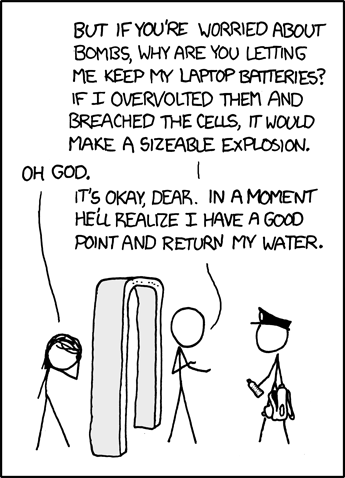
xkcd - A Webcomic - Bag Check


I like this, not for its humor, which I didn't find that funny. But for the fact that the TSA is horribly inconsistent.

They are in a difficult situation w/laptop batteries. If they prohibit them, then the airline business will tank as business customers find alternatives to airline travel that allow them to operate their laptops.

Trains between DC & New York would love this rule. As would the remote meeting services like GoTo Meeting, WebEX and Windows Live Meeting. Be suspicious of intentions if you ever hear any of the web conferencing providers advocating for tighter security at TSA.

Shared via AddThis

Sunday, October 18, 2009

Friday, October 16, 2009

AddThis :: Add-ons for Firefox

I think I may have found a way to blog more often. I've seen the "addthis" icons associated with different news sites. But it turns out that there's a firefox extension that allows me to share items of interest on my blog. So far, it looks pretty slick.
AddThis :: Add-ons for Firefox

Shared via AddThis

Thursday, October 08, 2009

New Comment System

I'm testing a new comment system on my blog. Can any one of my 5 loyal readers post a comment on the new system and let me know what you think?

NOTE: If you are reading this from facebook, the comment system for you is the facebook comment system. I've only changed the comments on my blog.  If you're reading this on facebook, you can ignore!

Tuesday, October 06, 2009

Strange Attractions

I find it odd that I'm attracted to women who aren't my wife. And I don't just mean a few women. I seem to be able to find something attractive about just about every woman I see. It's incredibly annoying. But more than that, I don't understand *why* it is.

To illustrate my confusion, let me describe an internal dialogue I have with a woman at my office whom I find more than normally attractive. I see her daily, but I avoid talking to her - mainly because I know I'm attracted and I need safe distance. Here's the entirely made up conversation that I have with her in my head.

Me: I don't understand why I'm attracted to you. It doesn't make sense.

Her: You mean you're attracted to me despite my obvious unattractiveness?!

[Note: in my subconscious, women are always trying to find some way to make what I say into a personal insult. It might have something to do with the fact that it frequently works that way in reality, too]

Me: No! I mean that I'm attractedd to you despite there being absolutely no upside to it, at any level. Think about it:
  1. You're a real person, but I'm only talking to a figment in my head. So being attracted to you has already made me slightly less sane.
  2. The odds of being rejected by you are pretty high, because
  • Your ring tells me you're married.
  • I'm just not that attractive

    I suspect that being rejected now is not any more fun than it was in high school and college.
  1. I'm married, so finding you attractive causes pain to my wife, whom I adore.
  2. In the unlikely event that you did *NOT* reject me, acting on this will ultimately cause me pain as all of the following would almost certainly happen:
  • I'd get caught
  • I'd damage my marriage, probably irreperably
  • I'd lose my kids (at worst) or lose their respect (at best)
  • I would (correctly) become a fool in the eyes of my friends and family
[End of conversation]

What is the possible benefit to *ANYONE* for me to continue to find random women attractive? Yet it still happens. And with a disturbing frequency. I wish there was an off switch. Because I can see no benefit to having this feature remain active.

From talking to my male friends, they seem to experience this about as much as I do. So it seems relatively normal. However, many of my friends simply can't talk to their wives about this at all, out of fear that just mentioning it will hurt their feelings and result in a huge fight. I count myself lucky that my wife (at some level) understands this, even if she doesn't feel it. To her, there is an off switch - at least from a visual sense. She got married. She's stopped searching for attractive men. She recognizes them, but it simply doesn't have any impact on her. For her to be really attracted to someone takes *much* more than just seeing them. At least she understands that it doesn't work that way for me. And she wishes that there was an off switch for me, too.

But the off switch doesn't seem likely to happen. So I keep my distance from women whom I find attractive. I just don't understand why this feature of being a male is necessary. I could really do without it.

Tuesday, September 15, 2009

Exports over Imports

The benefits of exports go to producers. The benefits of imports go to consumers.

When imports are cheaper than domestic products, the benefits of those imports are widely dispersed among consumers who save money. But because the benefits are dispersed this is a difficult group to politicize. On the other hand, it's very easy to create a political rally around producers. They tend to be concentrated in companies. Large companies are easy to find. Making it easy to organize events that stir up political will.

As a result, politicians, seeking votes, will almost always prefer to meet the needs of producers over the needs of consumers. This political tendency does not measure the relative benefits that accrue to producers & consumers, compare them, and select the maximum benefit. Rather, it measures only the benefits of exports and ignores entirely the benefits of imports, because the benefits of exports are much easier to convert to political capital.

Hence, we get tariffs on tires that provide huge benefits to tire manufacturers, but raises the cost of tires for the rest of us. This will distort the market in unanticipated ways. No one could have predicted that high fructose corn syrup (HFCS) would be the response to the tariff on sugar imports - hurting American sugar consumers without actually helping American sugar producers.

The Missing Tweets

I recently went on a cruise with my wife to celebrate 15 years of marriage. It was super fun. But I missed tweeting, because I was to far away from the internet to do anything. So I kept a memo on my phone that I called "The Missing Tweets" that captured my thoughts as I had them. This post captures what I would have tweeted if I had been able to tweet them:
  1. I think I like the Inspiration's deck plan better than Glory's.
  2. Boat feels bigger but only a little.
  3. I don't know if I'll be able to cruise again w/out a balcony.
  4. SUUUSHI!!! All you can eat! Can life get better?
  5. Curtis, where are you going?
  6. Curtis, where'd you go?
  7. Woah! Curtis, did you pass us and then get waay ahead? What are those lights up there that we aren't catching.
  8. Pretty blue water.
  9. Surrounded by blue water on all sides. It's only pretty b/c we're in a safe cocoon. The ocean is wilderness w/o this boat.
  10. I'm not as fascinated by the size of the boat this time around. But I should be.
  11. God bless margaritas - Cozumel
  12. Ughh. Too many margaritas.
  13. Not sleeping sucks.
  14. I miss internet access. Can't lookup the origins of "starboard" & "port"
  15. Wife & I watched two teenagers making out in hot tub. I wanted to knock on glass & give them thumbs up.
  16. Enjoying our dinner companions, Eric & Misty.
  17. I don't get singing & dancing shows. Was more interested in the gigantic sound board we sat behind.
  18. Watched a cool lightning show tonight from ship's bow. Then made out w/my wife.
  19. Weight gain! Possibly 10 lbs. Will only be certain when get back on same scale.
  20. Passed Curtis yesterday afternoon. This AM he's ahead of us. Did he pass us along same route or take quicker route?
  21. Raining on only *part* of boat.
NOTE: I did not, at the time, or now check that these would fit in the 140 char limit. But this is what I wrote down.

NOTE2: Curtis refers to my friend who happened to leave from the same port as we did on a different boat. We saw multiple Disney boats on our cruise. I just assumed all of them held my friend.

Tuesday, August 18, 2009

How To Link Calendars across Pre

Someone on twitter asked me how to share calendars between two Palm Pre phones. As I have one of these phones and I know (I think) that I can do it, here are some instructions:
  1. Create a google calendar account for each phone. This can be done here
  2. Go into each google account, and share that account with the other one
    1. Login to http://calendar.google.com
    2. Under "My calendars" on the left hand side, click the menu for your calendar, then choose "Share this calendar"
    3. In the screen that comes up, under "Share with specific people" add the email address of the other gmail account that you created.
  3. Connect each Pre to it's google calendar account. Do this by:
    1. Open calendar app on Pre
    2. Tap on "Calendar" menu
    3. Tap on "Preferences & Accounts"
    4. Tap on "Add An Account" (at the bottom)
    5. Enter the appropriate information to add the google account that you created
After doing this, both Palm Pre's should have read/write access to their own calendar, and read access to the other calendar.

Guilty.

A friend of mine made a commitment recently to not mix phone & driving. I, too, must confess that I do this. And I, too, am going to commit to not doing it any more.

Although I have a few caveats. I will answer & talk on the phone as I have a hands free system in my car. But I won't do anything that requires diverting my attention from the road. Examples:

  1. Reading an email, text, tweet, or web page
  2. Writing any of the same

Friday, July 10, 2009

Perspective

Previously, I tried to paint a picture of how President Obama's spending cuts sounded big, but weren't really. I think I did ok. But in comparison to this, I failed miserably.


And this